 |
Your travel guide to Kerala, South India
ONAM 2026: Kerala’s Grand Harvest Festival in South Indi
A symbol of Kerala’s rich cultural heritage, Onam marks the harvest season and commemorates the annual return of the legendary King Mahabali to his beloved people. For ten days, temples, villages, and cities are adorned with flowers, lights, and colorful decorations, offering visitors an unforgettable immersion into one of India’s most cherished traditions.
Kerala: A Unique State in India
Located on India’s southwestern coast, Kerala stands apart for its strong cultural identity and distinctive history. Famous for its lush landscapes, tranquil backwaters, tea and spice plantations, Kerala also boasts one of the highest literacy rates in the country and an exceptional quality of life.
In this diverse state, where different religious and cultural communities coexist harmoniously, Onam brings everyone together regardless of faith or background. The festival symbolizes unity, prosperity, and gratitude, attracting thousands of visitors from around the world every year.
The Legend of King Mahabali: The Origins of Onam
The story of Onam is deeply rooted in the legend of King Mahabali, an Asura (demon king) who once ruled Kerala.
Mahabali was renowned for his fairness, generosity, and benevolence. Under his reign, the kingdom flourished in peace and prosperity. His people lived happily, free from discrimination and social divisions.
However, Mahabali’s growing influence alarmed the celestial gods, who feared he would become more powerful than them. They sought the help of Lord Vishnu, the protector of the universe.
Vishnu descended to Earth in the form of Vamana, a dwarf Brahmin. He humbly requested from the king a piece of land measuring just three paces.
Confident and generous, Mahabali immediately agreed.
At that moment, Vamana revealed his divine form and grew to an enormous size. With his first step, he covered the heavens. With his second, he covered the Earth and the underworld.
Realizing that Vamana was Lord Vishnu himself and that there was nowhere left for the third step, Mahabali bowed in humility and offered his own head.
Vishnu placed his foot upon the king’s head and sent him to the underworld. Moved by Mahabali’s devotion and selflessness, Vishnu granted him one final wish: to return to Earth once every year to visit his people.
Since then, the people of Kerala have celebrated the annual homecoming of their beloved King Mahabali through the festival of Onam.
One of the Oldest Festivals in the World
According to historical and cultural traditions, Onam has been celebrated for over 1,200 years. Today, it is Kerala’s largest cultural event and one of India’s most significant festivals.
Recognized as Kerala’s state festival since 1961, Onam preserves the memory of the golden age associated with Mahabali’s reign while celebrating values of abundance, gratitude, and community spirit.
The Ten Days of Onam Celebrations
Although Onam was once celebrated for nearly a month, it is now observed over ten days, each carrying its own significance.
Atham: The Beginning of the Festival
The festivities begin with Atham, a day dedicated to prayer, house cleaning, and preparation.
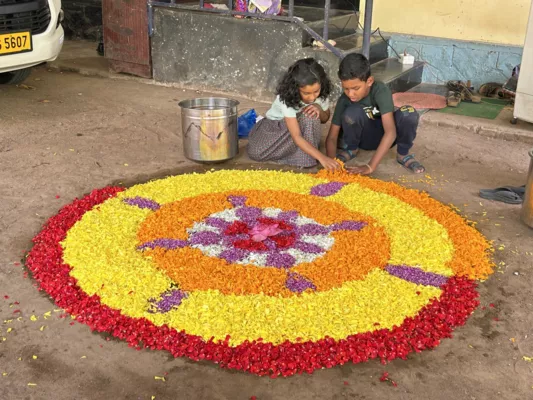
It also marks the start of creating the famous Pookalams, intricate floral carpets displayed in front of homes to welcome King Mahabali. Day after day, these floral designs become more elaborate, sometimes reaching several meters in diameter.
Many towns and villages organize competitions to reward the most beautiful Pookalam creations.
Traditional Preparations and Cultural Performances
From the second to the fourth day, markets become increasingly lively as families purchase festive goods and continue decorating their homes.
In Thrissur, the famous Pulikali, or “Tiger Dance,” attracts large crowds. Performers painted as tigers dance to the rhythm of traditional drums and reenact hunting scenes in a spectacular display of folk culture.
Vallamkali: The Famous Snake Boat Race
The fifth day features one of the festival’s most exciting events: Vallamkali, Kerala’s legendary snake boat race.
Held on the Pampa River and throughout Kerala’s backwaters, these long traditional boats—some measuring up to 45 meters (148 feet)—compete in thrilling races.
Hundreds of rowers paddle in perfect synchronization to the sound of traditional songs while thousands of spectators cheer from the riverbanks.
The event gained international fame thanks to the trophy established in 1952 by Jawaharlal Nehru, India’s first Prime Minister.
The Final Days Before Thiruvonam
The sixth and seventh days are dedicated to family gatherings and preparations.
On the eighth day, devotees create clay figurines representing Mahabali, known as Ma, and decorate them with flowers.
The ninth day is traditionally devoted to honoring elders by presenting them with agricultural produce and gifts from the year’s harvest.
Thiruvonam: The Most Important Day of the Festival
The tenth day, known as Thiruvonam, is the highlight of Onam celebrations.
According to tradition, this is the day when King Mahabali returns to visit his people.
From early morning, homes are decorated, temples welcome worshippers, and the Pookalams reach their final and most elaborate form.
Onam Sadya: A Magnificent Traditional Feast
The centerpiece of the day is the renowned Onam Sadya, an elaborate vegetarian banquet served on banana leaves.
The meal symbolizes prosperity and abundance, demonstrating to King Mahabali that his people continue to thrive.
A traditional Kerala saying captures its importance:
“We would attend the Onam Sadya even if we had to sell our house.”
The feast includes numerous traditional dishes such as rice, curries, vegetables, chutneys, pickles, fruits, and desserts. Every item is carefully placed on the banana leaf according to long-established customs.
A special drink made from boiled water infused with cumin and ginger is traditionally served alongside the meal.
Games, Music, and Traditional Dances
Throughout the day, communities participate in Onakalikal, a series of traditional games and sporting activities.
These include:
-
Ambeyyal (traditional archery)
-
Ball games
-
Strength competitions
-
Chess and card games
-
Traditional women's dances
-
Folk songs dedicated to Onam
The Majestic Elephant Processions of Thrissur
Among the most impressive spectacles are Kerala’s famous elephant processions.
Adorned with silk garments, golden ornaments, and ceremonial decorations, the elephants parade through the streets accompanied by traditional percussion ensembles, creating a breathtaking display for locals and visitors alike.
Gifts and Fireworks
Because Onam also marks the beginning of a new agricultural cycle in the Malayalam calendar, it is customary to offer new clothes and gifts to family members.
The celebrations conclude with dazzling fireworks that illuminate the Kerala sky.
Why Experience Onam in 2026?
Attending Onam is undoubtedly one of the best ways to discover the soul of Kerala. With its ancient traditions, colorful celebrations, exceptional cuisine, and legendary hospitality, the festival offers an authentic and unforgettable experience of South Indian culture.
For travelers, it is a unique opportunity to witness snake boat races, admire giant floral carpets, enjoy a traditional Onam Sadya feast, and participate in one of the most fascinating cultural events on the Indian subcontinent.